What Does “HRM” Mean?
The most common meaning of HRM is:
Human Resource Management
Human Resource Management refers to the process of recruiting, developing, managing, and supporting employees within an organization.
Quick Definition
HRM (Human Resource Management) is the strategic approach to managing people in a workplace to help both employees and organizations succeed.
Human Resource Management includes activities such as:
- Hiring employees
- Employee training
- Performance management
- Compensation and benefits
- Workplace policies
- Employee relations
In modern organizations, HRM plays a central role in business success.
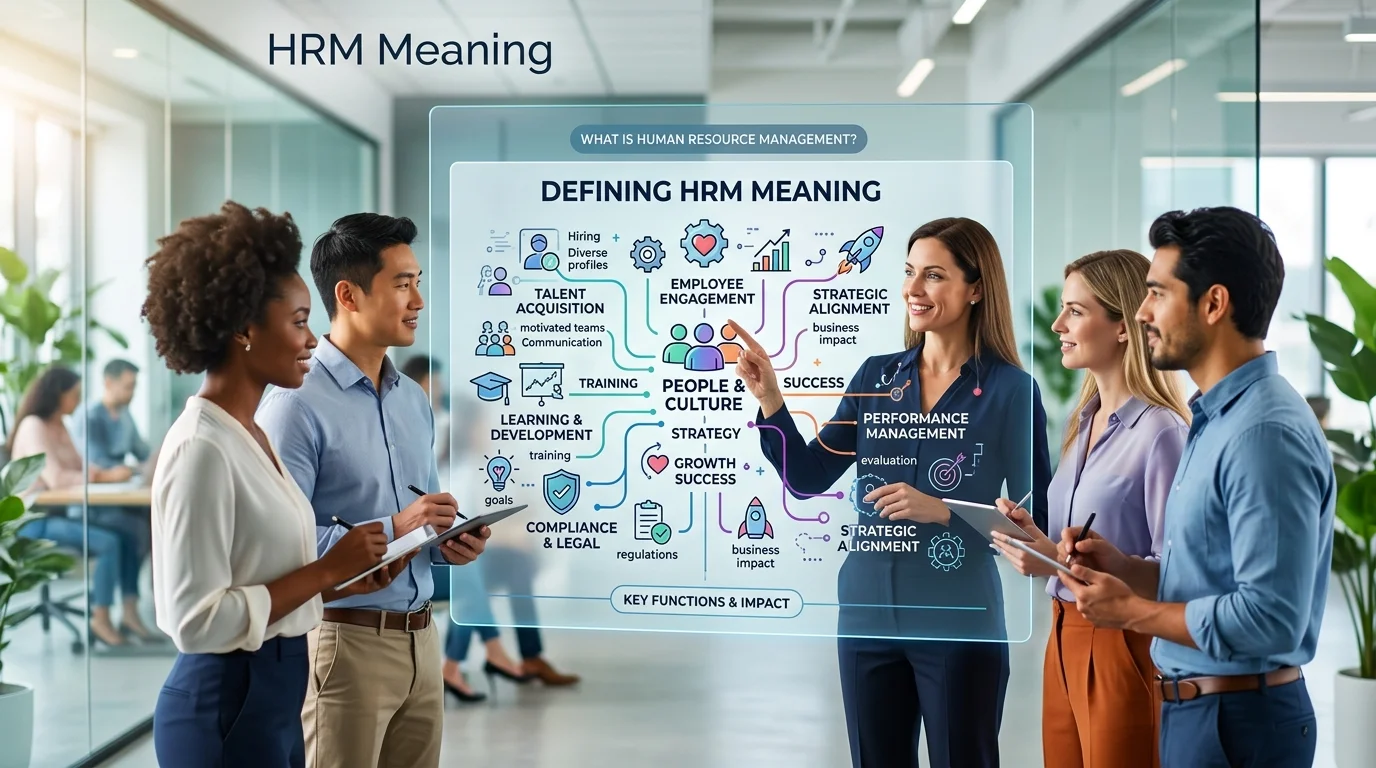
HRM Meaning in Business
In business and management, HRM is one of the most important organizational functions.
Core Purpose of HRM
The goal of Human Resource Management is to ensure that an organization has:
- The right people
- In the right roles
- At the right time
- With the right skills
Effective HRM helps companies attract and retain talented employees.
Why HRM Matters
Organizations rely on HRM to:
- Improve productivity
- Support employee growth
- Reduce turnover
- Maintain legal compliance
- Build positive workplace cultures
Without effective HRM, companies often struggle with staffing, morale, and performance issues.
Main Functions of Human Resource Management
1. Recruitment and Hiring
HR professionals help organizations find qualified candidates.
Responsibilities include:
- Posting job openings
- Reviewing resumes
- Conducting interviews
- Selecting employees
2. Training and Development
HRM supports employee learning through:
- Orientation programs
- Skill development
- Leadership training
- Professional education
3. Performance Management
Organizations use HRM systems to:
- Evaluate employee performance
- Set goals
- Provide feedback
- Improve productivity
4. Compensation and Benefits
HR departments manage:
- Salaries
- Bonuses
- Insurance programs
- Retirement plans
- Employee incentives
5. Employee Relations
HR professionals often help resolve:
- Workplace conflicts
- Employee concerns
- Policy questions
- Communication issues
HRM Meaning in Education
Many colleges and universities offer courses and degree programs focused on HRM.
What Students Learn
HRM programs often cover:
- Organizational behavior
- Labor relations
- Recruitment strategies
- Employment law
- Leadership principles
- Workforce planning
Graduates often pursue careers in human resources, management, recruiting, and organizational development.
HRM Meaning in Job Titles
You may see HRM used in professional contexts such as:
- HRM Specialist
- HRM Consultant
- HRM Coordinator
- HRM Manager
- HRM Executive
These professionals help organizations manage their workforce effectively.
HRM Meaning in Text and Online Chat
Although much less common, HRM sometimes appears in informal online communication.
HRM as a Thinking Sound
Some people use “hrm” similarly to:
- Hmm
- Hmmm
- Hmmm
Example:
Person A: “Should we try the new restaurant?”
Person B: “HRM… maybe.”
In this context, HRM suggests:
- Thinking
- Hesitation
- Consideration
However, this usage is informal and less common than the business definition.
How “HRM” Is Used in Real Conversations
Workplace Example
Employee: “What department handles employee benefits?”
Manager: “That’s part of HRM.”
Meaning:
Human Resource Management oversees benefits administration.
University Example
Student: “What’s your major?”
Friend: “I’m studying HRM.”
Meaning:
They’re studying Human Resource Management.
Hiring Example
Candidate: “Who manages recruitment?”
Recruiter: “Our HRM team handles that.”
Meaning:
The Human Resource Management department oversees hiring.
Informal Text Example
Friend 1: “Want to watch a movie tonight?”
Friend 2: “HRM, let me think about it.”
Meaning:
The person is considering the suggestion.
Benefits of Effective HRM
Organizations with strong Human Resource Management often experience several advantages.
Improved Employee Satisfaction
Employees feel more supported and engaged.
Better Recruitment
Companies attract stronger candidates.
Higher Productivity
Well-managed teams often perform more effectively.
Reduced Turnover
Employees are more likely to stay with the organization.
Stronger Workplace Culture
HRM helps create positive and collaborative work environments.
Common Mistakes & Misunderstandings
Mistake #1: Thinking HRM and HR Are Exactly the Same
Although closely related, they are not identical.
HR
Refers to the Human Resources department or function.
HRM
Refers to the broader management strategy and processes involving employees.
HRM is generally considered a more comprehensive concept.
Mistake #2: Assuming HRM Only Handles Hiring
Recruitment is only one part of Human Resource Management.
HRM also includes:
- Training
- Compensation
- Employee relations
- Performance management
- Workforce planning
Mistake #3: Misinterpreting HRM in Text Messages
In casual texting, HRM may simply mean a thoughtful pause similar to “hmm.”
The surrounding conversation usually reveals the intended meaning.
Mistake #4: Believing HRM Is Only for Large Companies
Organizations of all sizes benefit from effective Human Resource Management practices.
Even small businesses rely on HRM principles.
HRM vs Human Resources
People often use these terms interchangeably, but there are differences.
Human Resources (HR)
Focuses on the people working within an organization.
Human Resource Management (HRM)
Focuses on managing and developing those people strategically.
In simple terms:
- HR = the workforce function
- HRM = the management approach
Related Business Terms
If you’re researching the HRM meaning, you may also encounter these related concepts.
Human Resources (HR)
Employee-focused organizational function.
Recruitment
The process of hiring employees.
Talent Management
Strategies for developing and retaining talent.
Employee Relations
Managing workplace relationships.
Organizational Development
Improving organizational effectiveness.
Workforce Planning
Forecasting staffing needs.
Performance Management
Evaluating and improving employee performance.
These concepts are closely connected to Human Resource Management.
Why HRM Matters in 2026
As workplaces continue evolving through technology, remote work, and changing employee expectations, HRM remains more important than ever.
Modern HRM focuses on:
- Employee well-being
- Diversity and inclusion
- Leadership development
- Workforce flexibility
- Organizational culture
Companies increasingly view effective HRM as a competitive advantage.