

What Does “Anagram” Mean?
An anagram is a word or phrase created by rearranging the letters of another word or phrase while using all the original letters exactly once.
Simple Definition
An anagram is a new word or phrase formed by changing the order of letters in an existing word or phrase.
Quick Examples
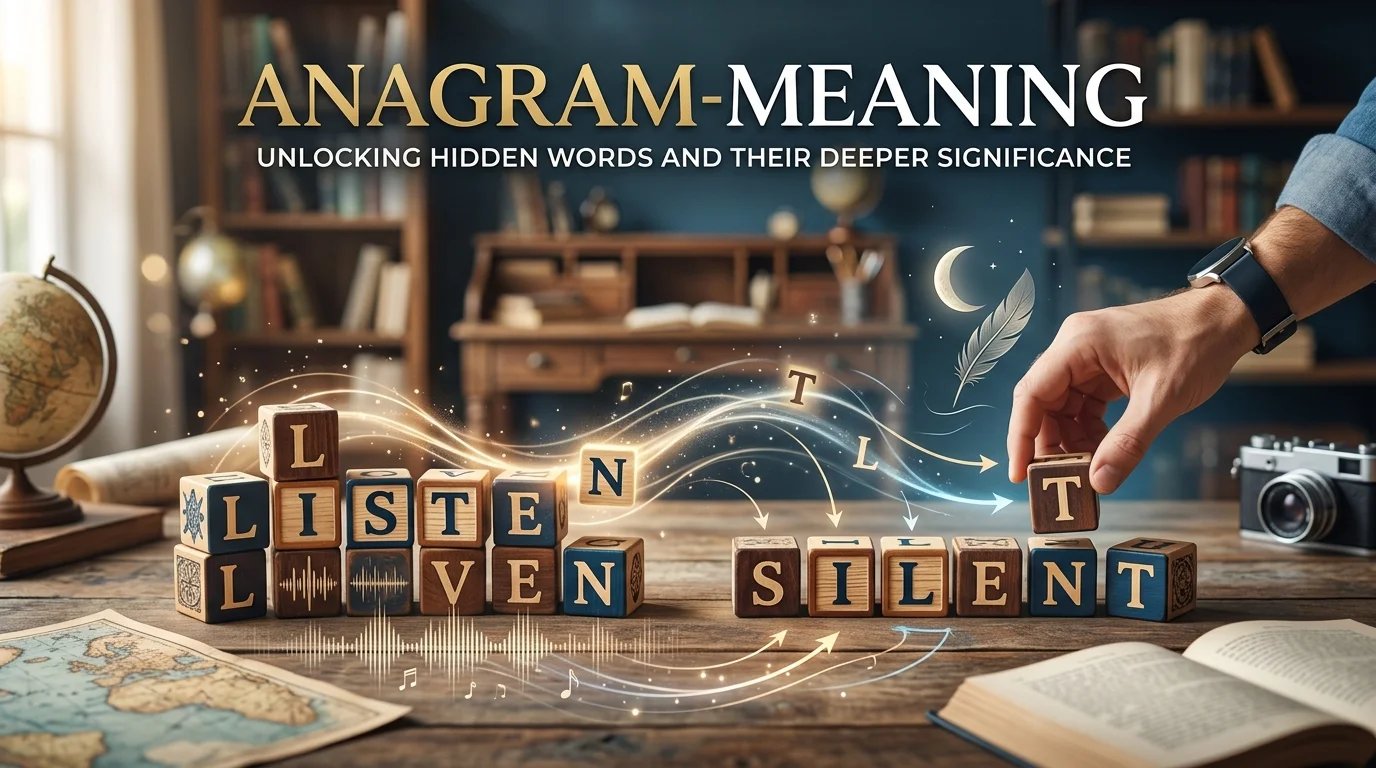
- Listen → Silent
- Below → Elbow
- Earth → Heart
- Night → Thing
- Angel → Glean
In each example, the same letters are used, but they are arranged differently to create a new word.
The Origin of the Word Anagram
The word anagram comes from Greek roots:
- Ana = back or again
- Gramma = letter
Together, the term essentially means:
“Letters rearranged.”
Anagrams have been used for centuries in literature, puzzles, and language games.
How Anagrams Work
The basic rule of an anagram is simple:
Requirements
You must:
- Use all original letters
- Use each letter the same number of times
- Rearrange the letters into a new word or phrase
Example
Original Word:
Care
Rearranged:
Race
Both words contain:
- C
- A
- R
- E
The letters are identical, but their order changes.
Anagram Meaning in Word Games
Anagrams are especially popular in word-based games.
Common Games That Use Anagrams
- Scrabble
- Wordscapes
- Word Cookies
- Crossword puzzles
- Jumble puzzles
- Online word games
Players often rearrange letters to discover hidden words and score points.
Why They Are Popular
Anagrams help improve:
- Vocabulary
- Spelling
- Pattern recognition
- Problem-solving skills
This combination of fun and mental challenge explains their lasting popularity.
Types of Anagrams
Not all anagrams look the same.
1. Single-Word Anagrams
One word becomes another word.
Examples:
- State → Taste
- Dusty → Study
- Save → Vase
2. Phrase Anagrams
Entire phrases are rearranged.
Example:
- Astronomer → Moon starer
This is one of the most famous anagram examples.
3. Name Anagrams
People sometimes create anagrams from names.
Example:
- Clint Eastwood → Old West Action
This type of anagram is often used for humor or creativity.
Anagram Meaning in Literature
Writers have used anagrams for centuries.
Common Literary Uses
Authors may use anagrams to:
- Create hidden clues
- Develop character names
- Add mystery
- Introduce secret messages
Readers often enjoy discovering these hidden linguistic connections.
Famous Example
In mystery novels and puzzle stories, anagrams sometimes reveal:
- A villain’s identity
- A hidden location
- An important clue
This makes them a popular storytelling device.
Anagram Meaning in Everyday Life
Although many people associate anagrams with puzzles, they appear in everyday situations as well.
Branding and Business
Companies sometimes create names using anagram-inspired techniques.
Usernames
Online users often rearrange letters to create unique usernames.
Social Media
Word games involving anagrams frequently trend on platforms such as:
- TikTok
- X
Classroom Activities
Teachers use anagrams to make language learning more engaging.
How “Anagram” Is Used in Real Conversations
Puzzle Example
Person A: “What exactly is an anagram?”
Person B: “It’s when you rearrange letters to create another word.”
Classroom Example
Teacher: “Can anyone find an anagram for ‘listen’?”
Student: “Silent!”
Game Example
Friend: “I finally solved that anagram puzzle.”
Friend 2: “What was the answer?”
Friend 1: “Heart from Earth.”
These examples show how naturally the term appears in conversations about language and puzzles.
Real Anagram Examples
Here are some popular examples.
Common Word Anagrams
| Original Word | Anagram |
|---|---|
| Listen | Silent |
| Earth | Heart |
| Dusty | Study |
| Save | Vase |
| Below | Elbow |
| Night | Thing |
| State | Taste |
| Angel | Glean |
Phrase Anagrams
- Astronomer → Moon starer
- The eyes → They see
- Conversation → Voices rant on
These examples demonstrate the creativity possible with anagrams.
Common Mistakes & Misunderstandings
Mistake #1: Using Different Letters
An anagram must use exactly the same letters.
Incorrect:
- Cat → Dog
Different letters make this impossible.
Mistake #2: Leaving Out Letters
Every original letter must appear in the new arrangement.
Example:
- Listen → Silent
Correct because all letters remain.
Mistake #3: Confusing Anagrams With Rhymes
Rhyming words are not necessarily anagrams.
Examples:
- Cat / Hat = rhyme
- Care / Race = anagram
These are different linguistic concepts.
Mistake #4: Confusing Anagrams With Acronyms
An acronym uses the first letters of multiple words.
Example:
- NASA
- FBI
An anagram rearranges letters to create a new word or phrase.
Benefits of Solving Anagrams
Many people enjoy anagrams because they provide mental stimulation.
Cognitive Benefits
Anagrams may help improve:
- Vocabulary skills
- Memory
- Concentration
- Problem-solving ability
- Language understanding
They are often used in educational and recreational settings for this reason.
Related Terms and Similar Concepts
If you’re researching the anagram meaning, you may also encounter these related terms.
Acronym
A word formed from the initials of other words.
Palindrome
A word or phrase that reads the same forward and backward.
Example:
- Level
- Madam
Wordplay
Creative manipulation of language.
Crossword
A puzzle involving word clues.
Jumble
A puzzle where letters are mixed and must be rearranged.
Linguistics
The scientific study of language.
These concepts are frequently discussed alongside anagrams.
Why Anagrams Remain Popular
Anagrams have survived for centuries because they combine:
- Creativity
- Logic
- Language
- Entertainment
From ancient literature to modern mobile games, people continue to enjoy the challenge of transforming letters into new meanings.
In today’s digital world, anagrams remain a favorite feature in puzzles, classrooms, social media challenges, and word games.