
What Does “Species” Mean?
Quick Definition
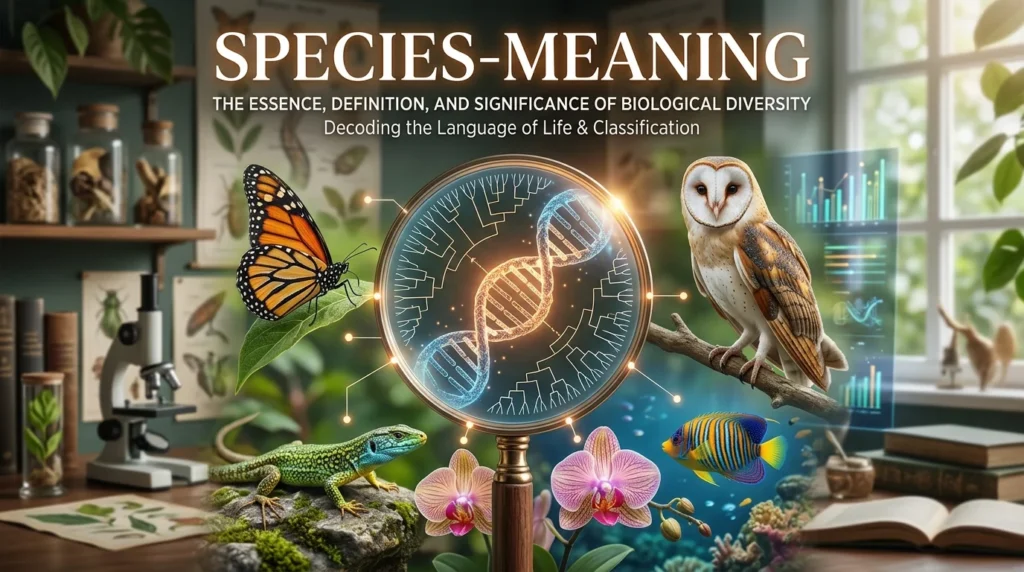
A species is a group of organisms that are similar enough to breed naturally and produce fertile offspring.
Species are one of the basic units used to classify living things.
Examples:
- Humans
- Dogs
- Cats
- Oak trees
- Blue whales
Each belongs to its own species.
Featured Snippet Answer
A species is a group of living organisms that share common characteristics and can reproduce naturally to produce fertile offspring.
Why Is the Concept of Species Important?
The idea of species helps scientists:
- Classify living organisms
- Study evolution
- Understand biodiversity
- Track endangered populations
- Research ecosystems
Without species classification, organizing life on Earth would be extremely difficult.
Species Meaning in Biology
In biology, a species is considered the most fundamental category of classification.
Scientists use species to group organisms that are closely related and capable of reproducing with one another.
For example:
Human Species
Humans belong to:
Homo sapiens
Every person on Earth belongs to this species.
Domestic Dog Species
Dogs belong to:
Canis lupus familiaris
Although dog breeds look different, they are considered part of the same species.
Cat Species
Domestic cats belong to:
Felis catus
Despite differences in color and size, domestic cats are classified within the same species.
How Species Are Named
Scientists use a system called binomial nomenclature.
Each species receives a two-part scientific name:
First Part: Genus
The broader group.
Second Part: Species
The specific organism.
Examples:
| Common Name | Scientific Name |
|---|---|
| Human | Homo sapiens |
| Lion | Panthera leo |
| Tiger | Panthera tigris |
| Gray Wolf | Canis lupus |
| House Cat | Felis catus |
This system allows scientists worldwide to identify organisms accurately.
How “Species” Is Used in Real Conversations
Although species is a scientific term, people use it regularly in education, documentaries, and everyday discussions.
Educational Settings
Examples:
- “How many species live in the rainforest?”
- “Humans are one species among millions.”
Nature Conversations
Examples:
- “That bird belongs to a rare species.”
- “Several species are endangered.”
Environmental Discussions
Examples:
- “Climate change affects many species.”
- “Protecting species helps preserve ecosystems.”
Documentaries and Media
Examples:
- “This species evolved over millions of years.”
- “Scientists recently discovered a new species.”
Real Examples of Species
Example 1: Humans
Scientific name:
Homo sapiens
All modern humans belong to the same species.
Example 2: Lions
Scientific name:
Panthera leo
Lions are a distinct species found primarily in Africa.
Example 3: Tigers
Scientific name:
Panthera tigris
Tigers are separate from lions despite belonging to the same genus.
Example 4: Blue Whales
Scientific name:
Balaenoptera musculus
The largest animal on Earth is its own species.
Example 5: Giant Pandas
Scientific name:
Ailuropoda melanoleuca
Giant pandas are a unique species native to China.
What Makes a Species Different From Another Species?
Scientists typically look at several factors.
Ability to Reproduce
Members of the same species can generally reproduce together.
Example:
- Dog + Dog = Fertile offspring
Genetic Similarity
Species often share significant genetic characteristics.
Physical Characteristics
Scientists examine:
- Body structure
- Size
- Appearance
- Anatomy
Behavioral Traits
Behavior can also help identify species.
Examples:
- Mating habits
- Feeding patterns
- Communication styles
Species and Evolution
The concept of species is closely tied to evolution.
Over long periods, populations can change and become different enough to form new species.
This process is called:
Speciation
Speciation occurs when groups of organisms evolve separately until they can no longer naturally reproduce together.
Examples include:
- Geographic isolation
- Environmental changes
- Genetic mutations
Over millions of years, speciation has produced the incredible diversity of life found on Earth today.
How Many Species Are There?
Scientists have identified millions of species.
These include:
- Animals
- Plants
- Fungi
- Bacteria
- Protists
However, many species remain undiscovered.
Researchers estimate that Earth may contain millions more species that have not yet been formally identified.
Common Mistakes & Misunderstandings
Mistake #1: Thinking Species Means Any Group of Animals
Incorrect:
“All birds are one species.”
Reality:
Birds include thousands of different species.
Mistake #2: Confusing Species With Breed
Many people mix up species and breed.
Example:
- Labrador
- German Shepherd
- Poodle
These are different dog breeds, not different species.
All belong to the same species.
Mistake #3: Assuming Similar Appearance Means Same Species
Some organisms look alike but belong to different species.
Physical appearance alone is not enough for classification.
Mistake #4: Thinking New Species Never Appear
Evolution continues today.
New species can emerge through speciation over long periods.
Mistake #5: Believing Humans Are Separate From Nature
Humans are a species just like other living organisms.
We are part of Earth’s biological diversity.
Species vs. Genus: What’s the Difference?
A common source of confusion is the difference between species and genus.
Species
A specific group of organisms.
Example:
sapiens
Genus
A broader category containing related species.
Example:
Homo
Together:
Homo sapiens
The genus includes closely related species, while the species identifies the exact organism.
Species vs. Population
These terms are not the same.
Species
A complete biological classification.
Example:
All humans worldwide.
Population
A specific group within a species.
Example:
Humans living in a particular country.
A species can contain many populations.
Related Biological Terms
If you’re researching species meaning, you may also encounter these related concepts.
Genus
A classification category above species.
Taxonomy
The science of classifying living organisms.
Evolution
The process by which species change over time.
Biodiversity
The variety of life on Earth.
Ecosystem
A community of living organisms interacting with their environment.
Speciation
The formation of new species.
Classification
The organization of organisms into groups.
These topics provide excellent internal linking opportunities for educational and science-focused websites.
Why Understanding Species Matters in 2026
Understanding species is more important than ever because of global challenges such as:
- Habitat loss
- Climate change
- Pollution
- Extinction risks
- Conservation efforts
Scientists rely on species classification to:
- Protect endangered wildlife
- Preserve biodiversity
- Monitor ecosystems
- Understand evolution
The concept of species remains one of the foundations of modern biological science.