
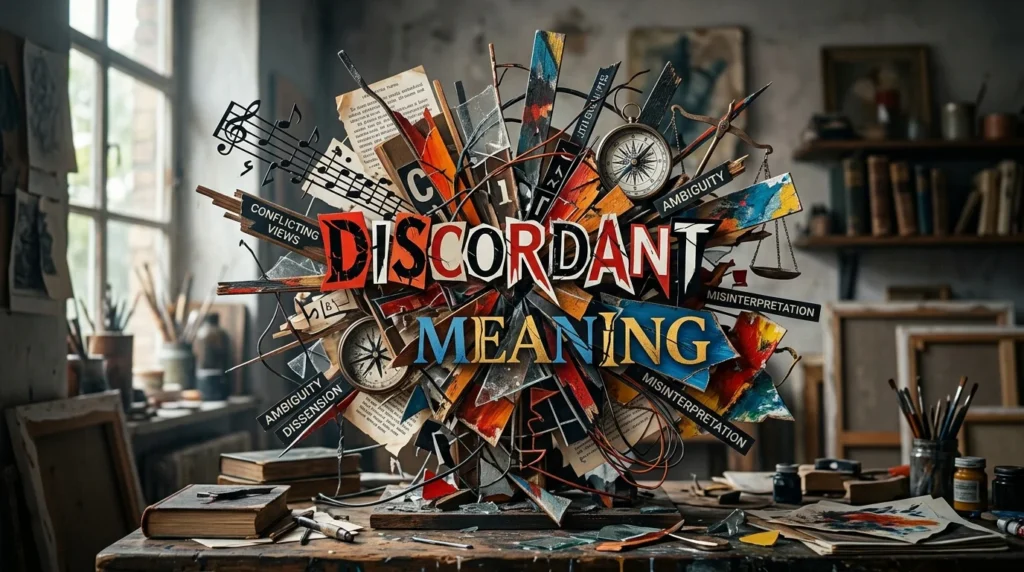
What Does “Discordant” Mean?
The word discordant is an adjective that means:
Not in agreement, not in harmony, or producing a harsh or unpleasant combination.
It comes from the root word “discord,” which refers to conflict, disagreement, or lack of harmony.
Simple Definition:
- Discordant = clashing, mismatched, or unpleasantly out of harmony
Core Ideas Behind the Word:
- Lack of agreement (opinions or ideas)
- Harsh or jarring sounds
- Visually or emotionally unbalanced combinations
Different Meanings of “Discordant” in Various Contexts
The meaning of discordant can slightly change depending on where it is used. Let’s explore the main contexts.
🎵 1. Discordant in Music (Most Common Use)
In music, discordant refers to sounds that are harsh or not pleasant when played together.
- Notes that clash instead of harmonizing
- Sounds that feel uncomfortable or tense
Example:
“The violin produced a discordant sound during the performance.”
👉 Here, it means the sound was out of harmony or unpleasant.
🧠 2. Discordant in Ideas or Opinions
When used in conversation or writing, discordant describes disagreement or conflicting viewpoints.
Example:
“The committee had discordant opinions about the new policy.”
👉 Meaning: People did not agree with each other.
🎨 3. Discordant in Visual or Emotional Contexts
It can also describe something that feels visually or emotionally unbalanced.
Example:
“The painting used discordant colors that made viewers uncomfortable.”
👉 Meaning: The colors clashed instead of blending nicely.
📚 4. Academic or Formal Writing Use
In literature, research, or formal English, discordant is often used to describe contrast or conflict between elements.
- Data can be discordant
- Theories can be discordant
- Observations can be discordant

How “Discordant” Is Used in Real Life
Understanding discordant meaning in real communication becomes easier when you see where it appears.
🎓 Academic Writing
- Used in essays, research papers, and analysis
- Common in science, sociology, and literature
Example:
“The results were discordant with previous studies.”
🎶 Music Reviews
- Used to describe experimental or unusual sounds
Example:
“The band’s new album features discordant jazz elements.”
📰 News & Formal Reports
- Used when describing disagreement or conflict
Example:
“There were discordant reactions to the new law.”
💬 Everyday English (Less Common)
- Rare in casual texting or slang
- Mostly replaced by simpler words like:
- “clashing”
- “not matching”
- “in disagreement”
Real-Life Examples of “Discordant” in Sentences
Here are simple examples to help you understand how the word is used:
Example 1: Music Context
“The orchestra hit a discordant note that stood out immediately.”
👉 Meaning: A sound that didn’t fit the harmony.
Example 2: Opinion Context
“The team gave discordant feedback on the design.”
👉 Meaning: The team members disagreed.
Example 3: Visual Context
“The room had discordant colors that felt overwhelming.”
👉 Meaning: The colors didn’t match well.
Example 4: Academic Context
“The data sets were discordant, suggesting an error in collection.”
👉 Meaning: The results did not align.
Common Mistakes & Misunderstandings
Because discordant is a formal word, learners often misuse it.
❌ Mistake 1: Thinking it only applies to music
While common in music, it also applies to ideas, visuals, and data.
❌ Mistake 2: Confusing it with “discord” (the app)
“Discordant” has nothing to do with the Discord app. It simply shares a root word.
❌ Mistake 3: Using it in casual texting
In everyday chat, saying “That’s discordant” sounds unnatural. People usually say:
- “That doesn’t match”
- “That feels off”
❌ Mistake 4: Using it as a noun
“Discordant” is an adjective, not a noun.
- Correct: “discordant sounds”
- Incorrect: “a discordant”
Related Words & Synonyms
To fully understand discordant meaning, here are similar words:
🔹 Clashing
- Things that don’t go together well
🔹 Dissonant
- Especially used in music; very close synonym
🔹 Inharmonious
- Not in harmony or agreement
🔹 Conflicting
- Used for ideas or opinions that disagree
🔹 Jarring
- Something unpleasant or shocking in tone or appearance
Why “Discordant” Is Important in English
The word discordant is useful because it adds precision in formal communication. Instead of saying something is “bad” or “wrong,” it explains how things don’t fit together.
It is especially useful in:
- Academic writing
- Music theory
- Critical analysis
- Professional reports