

Commute Meaning in Urdu
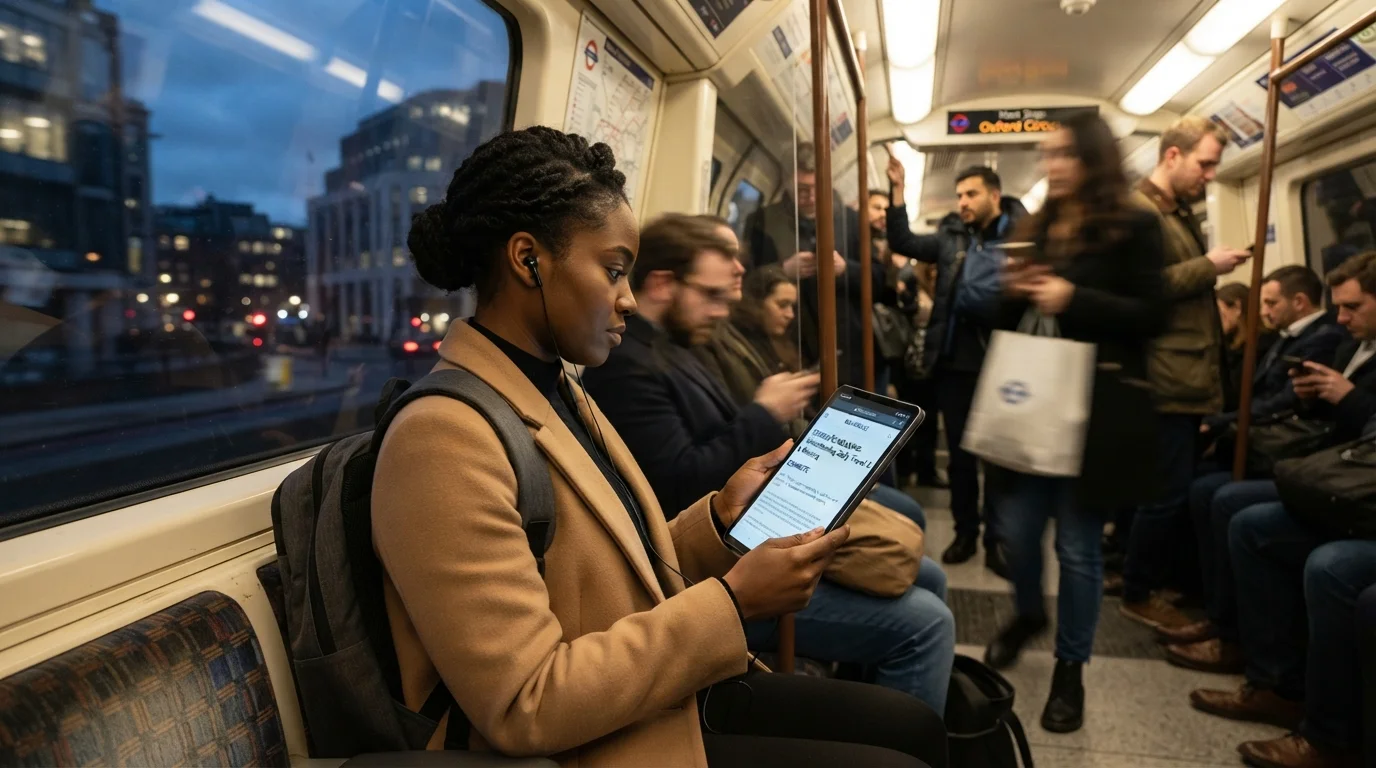
The word commute is commonly used to describe the act of traveling regularly between home and a workplace, school, or another destination. Commute meaning in Urdu is روزانہ آنا جانا, سفر کرنا, or آمد و رفت کرنا. It usually refers to a routine journey that people make every day.
For example, a person who lives outside the city and travels to the office every morning is said to commute.
Examples
- I commute to work by bus every day.
- میں ہر روز بس کے ذریعے دفتر جاتا ہوں۔
- She has a one-hour commute to university.
- اسے یونیورسٹی جانے میں ایک گھنٹہ لگتا ہے۔
Synonyms
- Travel
- Journey
- Go back and forth
- Shuttle
In everyday English, the word commute is mostly associated with transportation and daily travel.
Commute Meaning in Law
In legal terminology, commute means to reduce or substitute a punishment with a less severe one without canceling the conviction. A government authority, president, or governor may commute a prison sentence or death penalty to a lighter punishment.
Unlike a pardon, commuting a sentence does not declare a person innocent. It only changes the severity of the punishment.
Example
- The governor commuted the prisoner’s death sentence to life imprisonment.
- The president commuted several sentences after reviewing their cases.
Key Points
- Reduces a punishment.
- Does not erase the conviction.
- Requires legal authority.
Commute Meaning in Maths
In mathematics, commute refers to an operation that gives the same result even when the order of the numbers is changed. This concept is known as the commutative property.
Addition and multiplication are commutative operations because changing the order does not change the answer.
Examples
- 4 + 7 = 7 + 4
- 5 × 3 = 3 × 5
However, subtraction and division do not commute.
Examples
- 8 − 3 ≠ 3 − 8
- 12 ÷ 4 ≠ 4 ÷ 12
Understanding when operations commute is an important concept in algebra and higher mathematics.
Commute Meaning in Travel
In travel, commute means making a regular journey between home and another location, usually for work, education, or business. Unlike tourism or vacations, commuting is repetitive and part of a daily routine.
People commute using various forms of transportation such as:
- Car
- Bus
- Train
- Metro
- Bicycle
- Motorcycle
- Walking
Example
- Many employees commute from nearby towns to the city every morning.
- His daily commute takes about 45 minutes.
A commuter is someone who regularly makes this journey.
Commute Meaning in Relationship
The word commute is not commonly used in relationship discussions. However, it may appear when talking about couples who travel regularly to see each other or who have long-distance relationships.
For example, one partner may commute every weekend to spend time with the other.
Examples
- He commutes two hours every weekend to visit his partner.
- Their relationship works because both are willing to commute long distances.
In this context, commute simply means traveling regularly rather than expressing an emotional or romantic concept.
Commute Meaning in Physics
In physics, particularly quantum mechanics, commute describes whether two mathematical operators can be applied in any order without changing the result.
If two operators commute, their order does not matter.
Mathematically:
AB = BA
If they do not commute:
AB ≠ BA
This concept is essential in quantum physics because it determines whether two physical quantities, such as position and momentum, can be measured simultaneously with complete accuracy.
Example
Some quantum operators commute, while others do not, leading to important principles such as the uncertainty principle.
Commute Meaning in Insurance
In insurance, commute means converting future periodic payments into a single lump-sum payment.
This term is commonly used in:
- Life insurance
- Pension plans
- Annuities
- Workers’ compensation
Instead of receiving monthly or yearly payments, the policyholder agrees to receive one calculated amount at once.
Example
- The insurance company commuted the claimant’s monthly benefits into a lump-sum settlement.
Benefits
- Immediate access to money.
- Simplifies long-term payment obligations.
- Often used during claim settlements.
Commute Meaning in Finance
In finance, commute generally refers to converting a series of future financial payments into a present lump-sum amount. Although the term is less common in general finance than in insurance, it is frequently used in pension planning and structured settlements.
The lump sum is usually calculated using present value formulas that account for interest rates and expected future payments.
Example
- The retiree decided to commute part of the pension into a lump-sum payment.
- The company offered employees the option to commute future benefits for immediate cash.
Financial Importance
Commuting financial benefits allows individuals to:
- Receive immediate funds.
- Invest the money independently.
- Meet urgent financial needs.
- Simplify long-term payment arrangements.
However, choosing a lump-sum payment should be carefully evaluated because it may reduce future guaranteed income.
Final Note
The meaning of commute changes depending on the context. In everyday English, it usually means traveling regularly between home and work or school. In law, it means reducing a punishment. In mathematics and physics, it describes operations or operators whose order may or may not affect the result. In insurance and finance, it refers to converting future payments into a lump-sum amount. Understanding the context helps determine the correct meaning of the word.
What Does “Commute” Mean in English?
The word commute has two main uses: it can be a verb or a noun, and both are related to traveling regularly.
Simple definition:
Commute = to travel regularly between your home and workplace or school
As a verb (action)
When you “commute,” it means you travel back and forth regularly.
- “I commute to work every day.”
- “She commutes by bus.”
As a noun (the journey itself)
A “commute” is the trip you take regularly between home and work/school.
- “My commute takes one hour.”
- “The morning commute is very busy.”
Key idea:
A commute is not a one-time trip. It is a repeated daily journey.
Commute Meaning in Daily Life (Simple Explanation)
In real life, commuting usually refers to:
- Going to work in the morning
- Coming back home in the evening
- Traveling to school or university regularly
Example situation:
If you live in a village and work in a city, you may:
- Travel every day or weekly
- Spend time on buses, trains, or cars
That regular travel is called your commute.
Types of Commute
People commute in different ways depending on where they live and how far they travel.
1. By Car
- Driving yourself to work or school
- Common in cities and suburbs
2. By Bus
- Affordable and widely used
- Often crowded during peak hours
3. By Train
- Faster for long distances
- Common in big cities
4. By Bicycle or Walking
- Short-distance commuting
- Healthier and cheaper option
5. Remote or Hybrid “No Commute”
- Working from home
- No physical travel required
How “Commute” Is Used in Real Conversations
The commute meaning in chat or speech is very natural and widely used in everyday English.
1. Workplace conversations
People often talk about how long their travel takes:
- “My commute is really long today.”
- “I prefer working remotely to avoid commuting.”
2. School and college
Students also use it:
- “My commute to university takes 45 minutes.”
- “The morning commute is exhausting.”
3. Casual conversations
Friends may compare travel experiences:
- “How’s your commute these days?”
- “That commute must be tiring!”
4. Online discussions
On social media or forums:
- “Worst part of my job is the commute.”
- “Love remote work—no commute anymore!”
When it fits naturally:
- Talking about work or school routines
- Discussing travel time
- Comparing living locations
When it feels unnatural:
- Random casual texting without context
- Emotional or slang-heavy conversations
- Non-travel topics
Real-Life Examples of “Commute”
Here are simple examples to clearly understand commute meaning in English sentences:
Example 1: Daily routine
Sentence:
“I commute to office by train every morning.”
Meaning:
The person travels to work regularly using a train.
Example 2: Long travel time
Sentence:
“My commute takes almost two hours every day.”
Meaning:
The daily travel between home and work is very long.
Example 3: Remote work comparison
Sentence:
“I enjoy remote work because I don’t have to commute anymore.”
Meaning:
Working from home removes the need for daily travel.
Example 4: Student life
Sentence:
“Her commute to school is only 15 minutes.”
Meaning:
She has a short daily trip to school.
Common Mistakes & Misunderstandings
Many learners misunderstand the commute meaning slang or English usage, so let’s clear up the confusion.
1. Thinking commute means “travel once”
❌ Wrong: “I commuted to Lahore last week.”
✔ Correct: “I traveled to Lahore last week.”
👉 Commute is repetitive, not a one-time trip.
2. Using it outside work/school context
❌ “I commute to the market.”
✔ “I go to the market.”
👉 Commute is usually for work or study, not casual errands.
3. Confusing verb and noun forms
- Verb: “I commute daily.”
- Noun: “My commute is long.”
👉 Both are correct but used differently.
4. Mixing it with general travel
- Travel = any movement
- Commute = regular work/school travel
👉 Not all travel is a commute.
Related Words & Similar Terms
To fully understand commute meaning in English, here are related terms:
1. Travel
General word for moving from one place to another.
2. Transit
Often used for public transportation systems.
3. Journey
A trip from one place to another (can be one-time or regular).
4. Ride
Informal term for a trip in a vehicle.
5. Traffic
Often connected to commuting during busy hours.
6. Remote work
Modern alternative where commuting is not needed.
Why “Commute” Is an Important Word Today
The word commute is more important than ever because:
- Millions of people travel daily for work
- Urban traffic is increasing worldwide
- Remote work has changed commuting habits
- People now compare commute time when choosing jobs or homes
It is a key word in:
- Job discussions
- Real estate decisions
- Urban planning topics
- Daily lifestyle conversations