

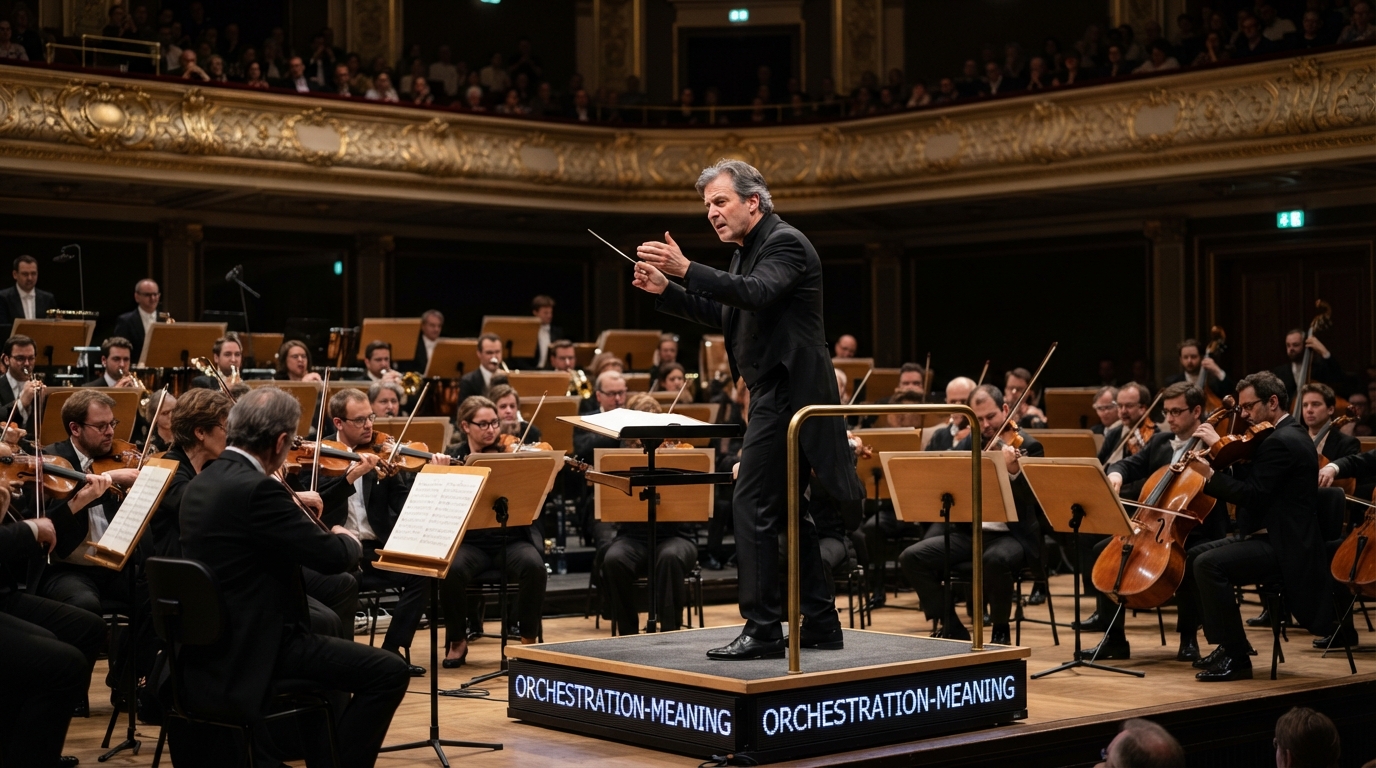
Orchestration Meaning
Orchestration refers to the process of coordinating, managing, and organizing multiple tasks, systems, people, or components so they work together efficiently toward a common goal. Originally used in music to describe arranging compositions for an orchestra, the term is now widely used in technology, business, marketing, biology, and artificial intelligence.
In modern industries, orchestration emphasizes automation, synchronization, and coordination, ensuring that different processes operate seamlessly.
Example:
Effective project orchestration helped the company launch its product on time.
AI orchestration automates multiple machine learning workflows.
Orchestration Meaning in Software
In software development, orchestration is the automated coordination and management of multiple applications, services, APIs, or workflows so they function together as a single system.
Rather than manually controlling each process, orchestration tools execute tasks in the correct order, monitor dependencies, handle failures, and improve operational efficiency.
Common Uses
Cloud computing
Microservices
DevOps automation
Workflow automation
CI/CD pipelines
Example
The software platform uses orchestration to deploy applications across multiple servers.
Workflow orchestration automatically triggers each step after the previous one finishes.
Benefits
Reduces manual work
Improves scalability
Minimizes errors
Speeds up deployments
Simplifies system management
Orchestration Meaning in Biology
In biology, orchestration describes the precise coordination of biological processes so that cells, tissues, organs, and molecules function together properly.
Scientists often use the term when discussing complex interactions such as:
Gene regulation
Cell communication
Immune responses
Embryonic development
Hormonal signaling
Example
The orchestration of gene expression determines how cells develop into different tissues.
Hormones play an important role in the orchestration of body functions.
Orchestration Meaning in AI
In artificial intelligence (AI), orchestration refers to coordinating multiple AI models, tools, data sources, and workflows to complete complex tasks automatically.
AI orchestration ensures that different AI components communicate efficiently while managing inputs, outputs, decision-making, and automation.
AI Orchestration May Include
Large Language Models (LLMs)
AI agents
Prompt workflows
Data pipelines
External APIs
Automation platforms
Example
The company uses AI orchestration to automate customer support.
Multiple AI agents work together through orchestration to solve complex problems.
Why It Matters
Improves automation
Enhances efficiency
Enables multi-agent collaboration
Reduces manual intervention
Creates scalable AI systems
Orchestration Meaning in English
In English, orchestration means the careful arrangement, coordination, or management of different elements to produce a desired result.
It can describe both literal and figurative coordination.
Examples
The orchestration of the concert impressed the audience.
Successful event orchestration requires detailed planning.
The CEO oversaw the orchestration of the company merger.
Pronunciation
Orchestration: /ˌɔːr.kɪˈstreɪ.ʃən/
Orchestration Meaning in Business
In business, orchestration refers to coordinating people, departments, technologies, and resources to achieve organizational goals efficiently.
Business orchestration ensures that sales, marketing, finance, operations, customer service, and supply chain activities work together instead of operating independently.
Examples
Business orchestration improved communication between departments.
Digital transformation requires effective orchestration of technology and employees.
Benefits
Better collaboration
Increased productivity
Faster decision-making
Improved customer experience
Reduced operational costs
Container Orchestration Meaning
Container orchestration is the automated management, deployment, scaling, networking, and monitoring of software containers.
As organizations run thousands of containers across multiple servers, orchestration platforms ensure applications remain available, balanced, and updated without manual intervention.
Container Orchestration Handles
Automatic deployment
Scaling applications
Load balancing
Self-healing containers
Resource allocation
Rolling updates
Service discovery
Example
Kubernetes is widely used for container orchestration in cloud environments.
Container orchestration automatically restarted failed application instances.
Why It Is Important
Supports cloud-native applications
Improves reliability
Reduces downtime
Simplifies infrastructure management
Data Orchestration Meaning
Data orchestration is the process of automatically collecting, organizing, moving, transforming, and managing data across multiple systems and platforms.
Instead of handling data manually, orchestration tools coordinate every stage of the data lifecycle.
Common Applications
Data integration
Data warehouses
Business intelligence
ETL and ELT pipelines
Analytics platforms
Example
Data orchestration ensures information flows smoothly between cloud applications.
The analytics team automated its reporting using data orchestration.
Benefits
Higher data quality
Faster analytics
Improved consistency
Reduced manual effort
Better governance
Orchestration Meaning in Marketing
In marketing, orchestration refers to coordinating marketing activities across multiple channels to deliver a consistent customer experience.
Rather than treating each channel separately, marketing orchestration connects them into one unified strategy.
Marketing Channels
Email marketing
Paid advertising
SMS campaigns
Websites
Mobile apps
Customer relationship management (CRM)
Example
Marketing orchestration personalized customer journeys across multiple channels.
The campaign combined email, social media, and SMS through marketing orchestration.
Benefits
Consistent messaging
Better customer engagement
Higher conversion rates
Personalized experiences
Improved marketing ROI
Synonyms of Orchestration
Depending on the context, common synonyms include:
Coordination
Organization
Management
Administration
Integration
Automation
Planning
Arrangement
Synchronization
Direction
Supervision
Control
Example Sentences Using Orchestration
AI orchestration allows multiple intelligent systems to work together.
Software orchestration simplified application deployment.
Effective business orchestration improved company performance.
Scientists studied the orchestration of cellular processes.
Marketing orchestration created a seamless customer experience.
Container orchestration reduced downtime across cloud services.
Data orchestration automated information flow between databases.
Frequently Asked Questions
What does orchestration mean?
Orchestration is the process of coordinating multiple tasks, systems, people, or technologies so they work together efficiently to achieve a common objective.
What is orchestration in software?
Software orchestration automates the coordination of applications, services, workflows, and infrastructure to improve efficiency and reliability.
What is AI orchestration?
AI orchestration manages multiple AI models, agents, tools, and workflows, enabling them to collaborate and automate complex business processes.
What is container orchestration?
Container orchestration automates the deployment, scaling, monitoring, networking, and management of software containers in cloud environments.
What is data orchestration?
Data orchestration automates how data is collected, processed, transformed, and delivered across different systems and applications.
What does orchestration mean in marketing?
Marketing orchestration coordinates campaigns across multiple channels to deliver consistent messaging and personalized customer experiences.
Conclusion
Orchestration means bringing multiple components together so they operate as one coordinated system. Whether used in software, AI, biology, business, container management, data engineering, or marketing, orchestration improves efficiency, automation, collaboration, and overall performance. As organizations increasingly rely on interconnected technologies, orchestration has become an essential concept for managing complex processes and achieving better outcomes.
What Does “Orchestration” Mean?
The word orchestration basically means organizing and coordinating different parts to work together smoothly.
Simple Definition:
Orchestration = the process of arranging and managing multiple elements so they work in harmony.
Core Idea:
- In music → arranging instruments
- In tech → coordinating systems or services
- In business → managing processes or workflows
So the meaning depends on where you see it, but the core idea is always:
“making many parts work together as one system.”
Orchestration Meaning in Music
The original meaning of orchestration comes from music.
In simple words:
It is the arrangement of music for an orchestra.
A composer decides:
- Which instruments play which parts
- When each instrument enters
- How the sound flows together
Example:
A song might include:
- Violins for melody
- Drums for rhythm
- Trumpets for power
All of this is carefully arranged through orchestration.
Simple music meaning:
Orchestration = designing how instruments combine in a musical piece.
Orchestration Meaning in Technology (Modern Use)
In modern tech, especially in cloud computing and AI, orchestration is a very important concept.
In IT terms:
Orchestration = automatically coordinating multiple software systems or services.
Example in cloud computing:
Imagine an app that needs:
- A database
- A server
- A storage system
Orchestration tools manage all of these automatically so they work together.
Popular use cases:
- Kubernetes container orchestration
- AI workflow orchestration
- Cloud service management
Simple tech meaning:
Orchestration = making different systems work together automatically.
Orchestration Meaning in Business
In business, orchestration refers to coordinating tasks, teams, or workflows efficiently.
Example:
A company launching a product must:
- Manage marketing
- Handle production
- Coordinate sales
Orchestration ensures everything happens at the right time.
Simple business meaning:
Orchestration = organizing people and processes to achieve a goal smoothly.
How “Orchestration” Is Used in Real Conversations
The orchestration meaning slang or casual use is rare, but the term is widely used in professional and technical contexts.
1. Music Discussions
- “The orchestration of this symphony is amazing.”
2. Tech Conversations
- “We use Kubernetes for orchestration.”
3. Business Strategy Talks
- “The orchestration of the campaign was flawless.”
4. AI & Automation
- “AI orchestration improves workflow efficiency.”
Real-Life Examples of Orchestration
Here are simple examples to understand orchestration meaning in context:
Example 1: Music
Teacher:
“This piece shows perfect orchestration.”
Meaning:
The instruments are arranged beautifully.
Example 2: Tech System
Developer:
“The system uses orchestration to manage microservices.”
Meaning:
Software components are automatically coordinated.
Example 3: Business Project
Manager:
“The orchestration of teams made the launch successful.”
Meaning:
All teams worked together smoothly.
Example 4: Everyday Life
Friend:
“Planning that wedding required serious orchestration.”
Meaning:
Many tasks were coordinated together.
Common Mistakes & Misunderstandings
The orchestration meaning in English is often misunderstood because it sounds complex.
1. Thinking it only means music
- Wrong: Orchestration is only about instruments
- Correct: It is used in tech, business, and automation too
2. Confusing it with “organization”
While similar:
- Organization = structure
- Orchestration = coordination of multiple moving parts
3. Assuming it is casual slang
- Orchestration is formal technical language, not internet slang
4. Overcomplicating the meaning
At its core:
Orchestration = making things work together smoothly
Related Terms & Similar Concepts
Here are related words that help explain orchestration meaning better:
1. Coordination
- Managing multiple tasks together
2. Automation
- Making processes run automatically
3. Integration
- Connecting different systems
4. Workflow
- Step-by-step process of work
5. Composition (music)
- Creating structured music pieces
6. Synchronization
- Timing things to work together
Why “Orchestration” Is Important Today
Orchestration is widely used in modern industries because:
- Systems are more complex than ever
- Automation saves time and reduces errors
- Businesses need smooth coordination
- AI and cloud computing rely heavily on it
In 2026, orchestration is especially important in:
- AI workflows
- Cloud platforms
- DevOps systems
- Digital business operations.