
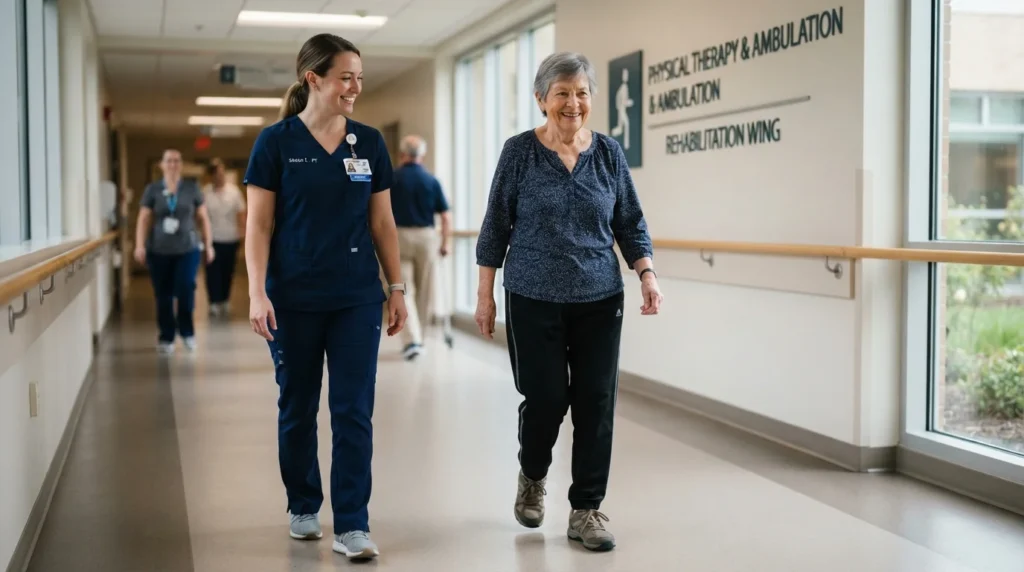

What Does “Ambulation” Mean in Simple Words?
At its core, ambulation means walking or the ability to walk.
Simple Definition:
Ambulation = the act of moving or walking from one place to another.
It is mostly used in:
- Medical reports
- Hospital care plans
- Physiotherapy notes
- Nursing documentation
Instead of saying “the patient is walking,” medical professionals often use the more formal term “ambulating.”
Easy Example:
- “The patient is able to ambulate independently.”
👉 This simply means: “The patient can walk on their own.”
Medical Background of “Ambulation”
The word ambulation comes from Latin:
- “ambulare” = to walk
In healthcare, it is used to describe:
- A patient’s mobility level
- Recovery progress after surgery
- Physical independence
- Rehabilitation milestones
Doctors and nurses use this term because it is:
- precise
- professional
- universally understood in medical communication
So instead of casual language like “he’s walking fine,” medical notes use ambulation status.
Types of Ambulation in Medical Context
To fully understand ambulation meaning in healthcare, it helps to know its common categories:
1. Independent Ambulation
The person can walk without help.
- Example: “Patient demonstrates independent ambulation.”
- Meaning: No assistance needed
2. Assisted Ambulation
The person needs support like:
- walker
- cane
- crutches
- caregiver assistance
- Example: “Patient requires assisted ambulation.”
- Meaning: Help is needed to walk safely
3. Non-Ambulatory
The person cannot walk at all.
- Example: “Patient is non-ambulatory post-surgery.”
- Meaning: Unable to walk due to condition or recovery stage
How “Ambulation” Is Used in Real Medical Conversations
The keyword “ambulation meaning medical” is common because it appears in hospital documentation everywhere.
1. After Surgery
- “Early ambulation is encouraged after surgery.”
👉 Meaning: Patients should start walking soon to recover faster.
2. Physiotherapy Sessions
- “Improving ambulation with physical therapy exercises.”
👉 Meaning: Helping patients regain walking ability.
3. Nursing Notes
- “Patient tolerated ambulation with minimal assistance.”
👉 Meaning: Patient was able to walk with a little help.
4. Emergency or Recovery Reports
- “Ambulation delayed due to pain.”
👉 Meaning: Patient cannot walk easily because of discomfort.
Real-Life Examples of “Ambulation”
Example 1: Hospital Report
“The patient was able to ambulate 20 meters with support.”
Meaning:
The patient walked a short distance with help.
Example 2: Physiotherapy Update
“Ambulation improving daily after knee surgery.”
Meaning:
Walking ability is getting better each day.
Example 3: Doctor’s Instruction
“Encourage ambulation to prevent blood clots.”
Meaning:
Doctors recommend walking to avoid complications.
Example 4: Caregiver Note
“Assisted ambulation required for bathroom use.”
Meaning:
The patient needs help walking for basic tasks.
Common Mistakes & Misunderstandings
The ambulation meaning is often misunderstood because it sounds technical.
Mistake 1: Thinking It Means Running or Exercise
Ambulation is not exercise-specific—it simply means walking or moving.
- ❌ Wrong: “Ambulation means jogging.”
- ✅ Correct: “Ambulation means walking or mobility.”
Mistake 2: Confusing It With “Ambulance”
These words are related in origin but not meaning:
- Ambulation = walking
- Ambulance = emergency medical vehicle
Mistake 3: Assuming It Only Means Full Walking Ability
Even limited movement counts as ambulation:
- with support
- with aids
- short distances
Mistake 4: Using It in Casual Conversation
In everyday slang or texting, people rarely say “ambulation.”
Instead, they say:
- walking
- moving
- getting around
Related Medical & Mobility Terms
If you’re learning “ambulation meaning slang/medical usage”, these related terms help:
- Mobility – overall ability to move
- Gait – style or pattern of walking
- Rehabilitation – recovery process after injury
- Physiotherapy – treatment to restore movement
- Non-ambulatory – unable to walk
- Assisted walking – walking with help
These terms are commonly used together in healthcare documentation.