
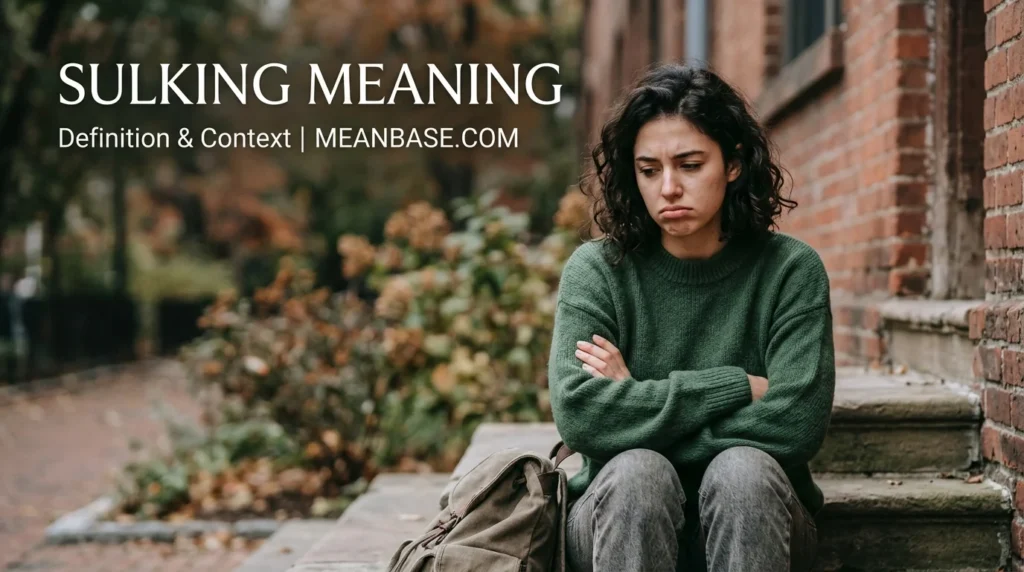
What Does “Sulking” Mean?
The meaning of sulking is:
👉 To stay silent, moody, or unhappy because you feel upset, ignored, or disappointed—often without openly expressing your feelings.
In simple words, sulking means:
- Being quiet because you’re annoyed
- Showing sadness or anger indirectly
- Acting moody instead of talking about the problem
It is often associated with emotional withdrawal or silent displeasure.
Simple Example:
If someone doesn’t get what they want and stops talking or behaves coldly, they might be sulking.
Sulking Meaning in Text or Chat (2026 Context)
In modern digital communication, “sulking” is often used to describe someone’s mood or behavior in a conversation.
It is not slang—it is a descriptive emotional term used in chats like:
- “Why are you sulking?”
- “Stop sulking and talk to me.”
- “He’s been sulking all day.”
In 2026 messaging culture, it is commonly used in:
- Relationships
- Friend arguments
- Family chats
- Gaming disputes
- Social media comments

How Sulking Meaning Is Used in Real Conversations (2026)
The word sulking appears when someone is emotionally withdrawn or silently upset.
1. Text Messaging
- “You’ve been sulking since morning, what happened?”
- “Don’t sulk, just tell me what’s wrong.”
Used when someone avoids communication after being upset.
2. Relationship Chats
- “Are you sulking because I didn’t reply?”
- “Stop sulking and talk to me properly.”
Very common in romantic communication when one person feels ignored or hurt.
3. Family Conversations
- “He’s sulking in his room again.”
- “She started sulking after the argument.”
Used to describe silent emotional reactions.
4. Social Media Posts
- “Me sulking after getting one-word replies 😭”
- “When plans get canceled and I’m just sulking”
Often used humorously or in relatable memes.
5. Gaming & Online Chats
- “Don’t sulk, it’s just a game”
- “He’s sulking after losing the match”
Used when players get emotionally upset after losing.
Real Text Message Examples of Sulking Meaning
Here are real-world style conversations to understand sulking meaning in chat (2026):
Example 1: Friendship Argument
A: Why aren’t you replying?
B: I’m not sulking, I’m just busy
Meaning: Denying being quietly upset.
Example 2: Relationship Scenario
A: You seem quiet today
B: Maybe I’m sulking a little
Meaning: Feeling upset but not expressing it openly.
Example 3: Family Situation
A: Where is your brother?
B: In his room, sulking again
Meaning: He is silently upset and withdrawn.
Example 4: Funny Social Media Context
Caption: “Me sulking after my favorite food runs out 😔”
Meaning: Lighthearted emotional reaction.
Example 5: Gaming Chat
A: You lost fair and square
B: I’m not sulking, just processing the loss
Meaning: Feeling disappointed but trying not to show it.
Common Mistakes & Misunderstandings About Sulking
Even in 2026, people misunderstand the word sulking in communication.
1. Thinking Sulking Means Silence Only
Sulking is not just being quiet—it includes:
- Moodiness
- Emotional withdrawal
- Visible or noticeable disappointment
2. Confusing Sulking With Ignoring
Ignoring someone is intentional avoidance, but sulking is emotional reaction, not necessarily intentional behavior.
3. Assuming It’s Slang
Sulking is not internet slang. It is standard English used in emotional and behavioral context.
4. Using It for Normal Quiet Behavior
Not all silence is sulking. Someone may simply be:
- Tired
- Busy
- Thinking
Sulking specifically involves emotional upset.
Related Words & Similar Terms
If you are learning sulking meaning in 2026, these related words will help you understand similar emotional expressions:
- Moody – Easily upset or emotionally low
- Pouting – Showing annoyance with facial expression
- Brooding – Deep, silent thinking with negative emotions
- Silent treatment – Deliberately not talking to someone
- Withdrawn – Emotionally distant behavior
- Upset – General emotional distress
- Irritated – Mild anger or frustration