
What Does “Same Word Different Meaning” Mean?
Simple Definition
Same word different meaning refers to a word that has multiple definitions depending on the context in which it is used.
In linguistics, these words are often called:
- Homonyms
- Polysemous words
- Multiple-meaning words
Featured Snippet Answer
What does same word different meaning mean?
Same word different meaning refers to a single word that can have two or more different definitions. The intended meaning depends on the context, sentence structure, and how the word is being used.
Why Does It Happen?
Languages evolve over time.
Words often develop new meanings because of:
- Cultural changes
- Technology
- Slang
- Historical developments
- Regional usage
As a result, one word may eventually represent multiple ideas.
Common Examples of Same Word Different Meaning
Let’s look at some everyday examples.
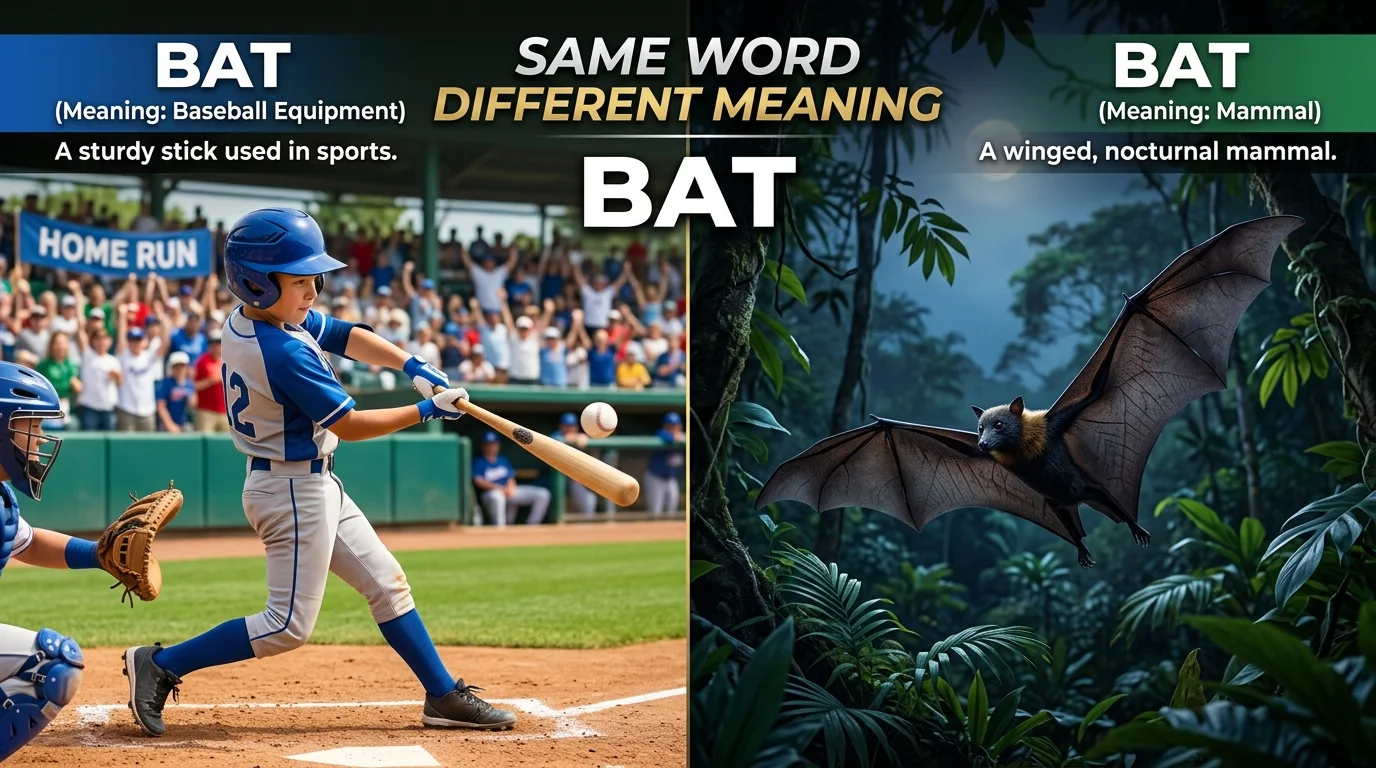
Bat
Meaning 1: A flying animal.
Example:
A bat flew out of the cave.
Meaning 2: Sports equipment used in baseball or cricket.
Example:
He swung the bat and hit the ball.
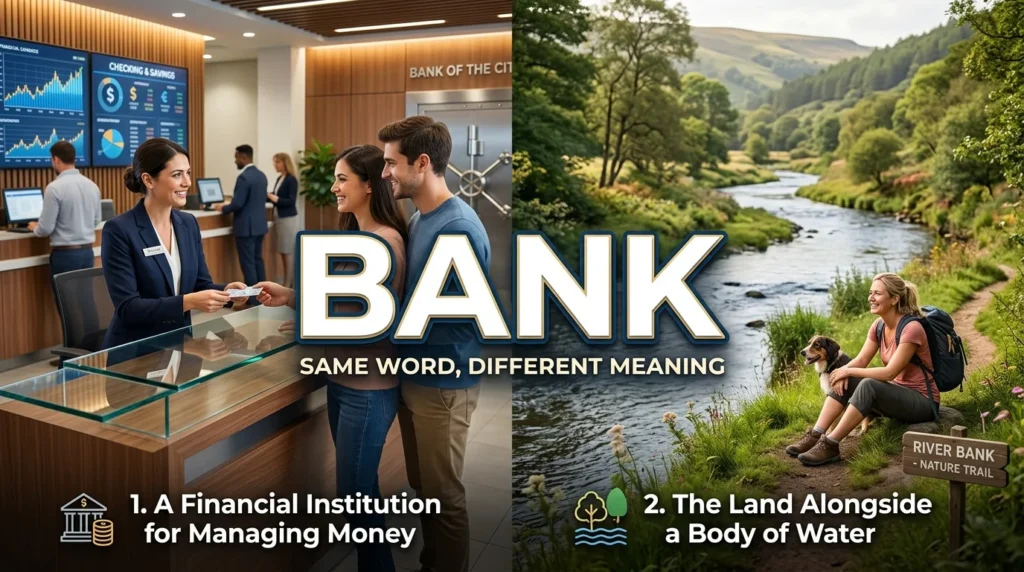
Bank
Meaning 1: A financial institution.
Example:
I deposited money in the bank.
Meaning 2: The side of a river.
Example:
They sat on the river bank.
Light
Meaning 1: Illumination.
Example:
Turn on the light.
Meaning 2: Not heavy.
Example:
This bag is light.
Ring
Meaning 1: A piece of jewelry.
Example:
She wore a gold ring.
Meaning 2: A sound made by a phone.
Example:
I heard the phone ring.
Date
Meaning 1: A calendar day.
Example:
What’s today’s date?
Meaning 2: A romantic meeting.
Example:
They went on a date.
Same Word Different Meaning in Text and Chat
The internet has created many new examples of words with multiple meanings.
Ghost
Traditional Meaning:
A spirit of a dead person.
Modern Slang Meaning:
To suddenly stop communicating with someone.
Example:
He ghosted me after two weeks.
Catfish
Traditional Meaning:
A type of fish.
Modern Slang Meaning:
Someone pretending to be another person online.
Example:
That profile turned out to be a catfish.
Flex
Traditional Meaning:
To bend a muscle.
Modern Slang Meaning:
To show off.
Example:
He’s just flexing his new car.
Viral
Traditional Meaning:
Related to a virus.
Modern Meaning:
Popular online content spreading rapidly.
Example:
That video went viral.
How Context Changes Meaning
Context is the key to understanding words with multiple meanings.
Consider the word “watch.”
Example 1
I bought a new watch.
Meaning:
A timepiece worn on the wrist.
Example 2
Watch where you’re going.
Meaning:
To look carefully.
The same word has completely different meanings depending on the sentence.
Same Word Different Meaning in Social Media
Social media has accelerated the creation of new meanings.
Words commonly used in multiple ways include:
Cooked
Traditional Meaning:
Prepared food.
Slang Meaning:
Defeated, exhausted, or in trouble.
Fire
Traditional Meaning:
Flames.
Slang Meaning:
Excellent or impressive.
Cold
Traditional Meaning:
Low temperature.
Slang Meaning:
Emotionally distant or impressive depending on context.
Sick
Traditional Meaning:
Ill.
Slang Meaning:
Amazing or impressive.
These evolving meanings are one reason why non-native English speakers often find internet slang confusing.
Types of Words With Different Meanings
Homonyms
Words that share the same spelling or pronunciation but have different meanings.
Examples:
- Bat
- Bank
- Bark
Homophones
Words that sound the same but have different meanings and spellings.
Examples:
- Their
- There
- They’re
Polysemy
A single word with multiple related meanings.
Example:
Head
- Part of the body
- Leader of an organization
- Front of a line
Why Learning Multiple Meanings Matters
Understanding multiple meanings helps improve:
Reading Skills
You’ll better understand books, articles, and online content.
Communication
You’ll avoid misunderstandings.
English Fluency
Language learners can interpret conversations more naturally.
Internet Literacy
Modern slang frequently creates new meanings for existing words.
Real-Life Examples
Example 1: School
Teacher: Open your book.
Student: Which book?
Simple words can require context for clarity.
Example 2: Workplace
Manager: Let’s address this issue.
Meaning:
Deal with the issue.
Not:
Provide a mailing address.
Example 3: Social Media
Comment: That outfit is fire.
Meaning:
The outfit looks great.
Not:
The outfit is burning.
Example 4: Dating
Friend: He ghosted me.
Meaning:
Stopped communicating.
Not:
Turned into a ghost.
Example 5: Sports
Commentator: He’s on fire tonight.
Meaning:
Performing exceptionally well.
Not:
Actually burning.
Common Mistakes & Misunderstandings
Mistake #1: Assuming Every Meaning Is Literal
Many modern meanings are slang or figurative.
Mistake #2: Ignoring Context
The surrounding words often reveal the intended meaning.
Mistake #3: Translating Word-for-Word
Language learners sometimes focus on only one definition and miss alternative meanings.
Mistake #4: Overlooking Slang
Internet culture constantly creates new meanings for existing words.
Related Language Terms
If you’re researching same word different meaning, you may also encounter:
Homonym
A word with multiple meanings or pronunciations.
Homophone
Words that sound alike but have different meanings.
Polysemy
One word having several related meanings.
Synonym
Words with similar meanings.
Antonym
Words with opposite meanings.
Slang
Informal language used within specific communities.