

What Does “Pomodoro” Mean?
Quick Definition
Pomodoro is a productivity and time-management method that involves working in focused sessions—traditionally 25 minutes long—followed by short breaks.
A single work session is called a Pomodoro.
For example:
- Work for 25 minutes
- Take a 5-minute break
- Repeat the cycle
After completing four Pomodoros, you take a longer break, usually 15–30 minutes.
What Does the Word Pomodoro Mean?
The word Pomodoro is the Italian word for tomato.
The technique gets its name from a tomato-shaped kitchen timer used by its creator when developing the method.
Today, the word has become synonymous with focused work and productivity.
Featured Snippet Answer
Pomodoro means a time-management technique where you work in focused intervals, usually 25 minutes, followed by short breaks to improve concentration and productivity.
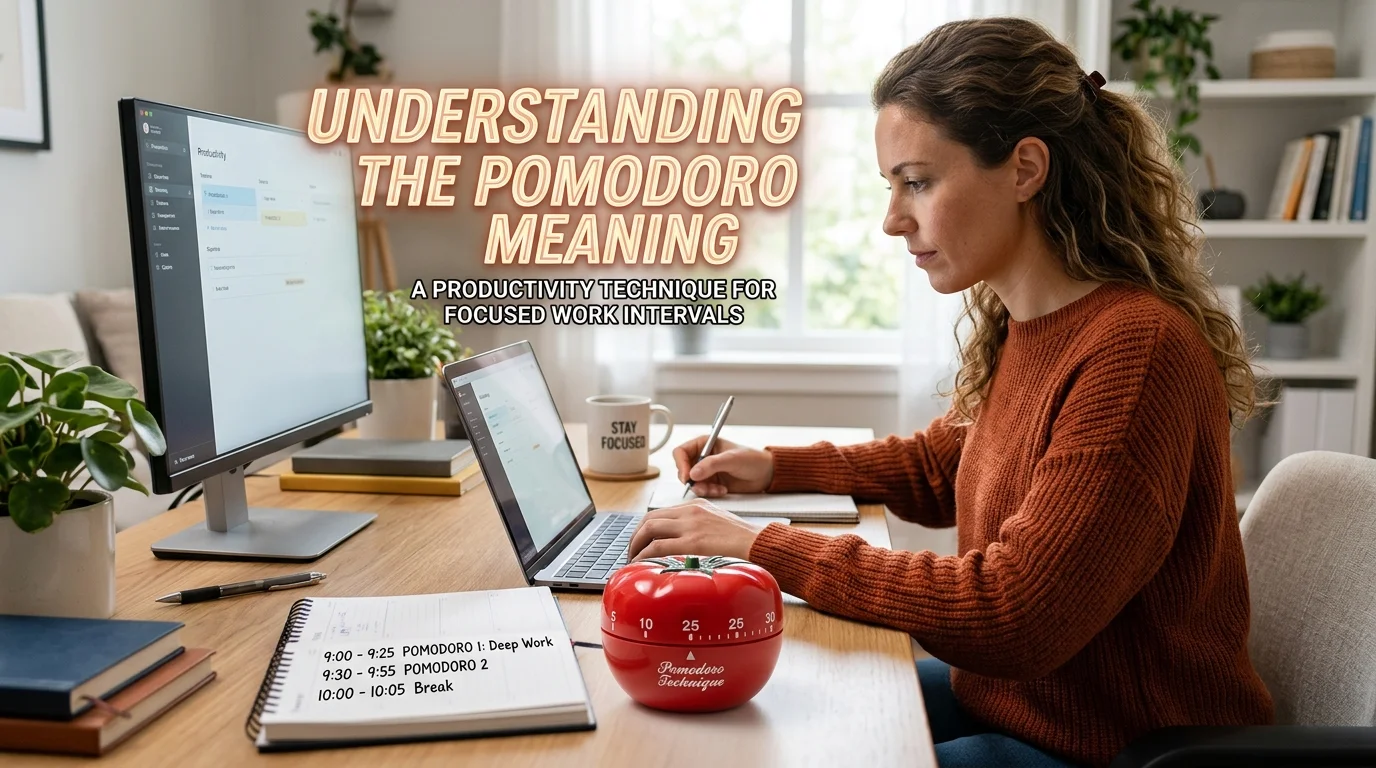
The Origin of the Pomodoro Technique
The Pomodoro Technique was created in the late 1980s by Francesco Cirillo.
As a university student, Cirillo struggled to stay focused while studying. He challenged himself to concentrate for a short period using a tomato-shaped kitchen timer.
The experiment worked surprisingly well.
Over time, he refined the system into what is now known worldwide as the Pomodoro Technique.
Today, the method is used by:
- Students
- Writers
- Software developers
- Entrepreneurs
- Researchers
- Remote workers
- Content creators
How the Pomodoro Technique Works
The classic Pomodoro process follows five simple steps.
Step 1: Choose a Task
Select one task you want to complete.
Examples:
- Writing an essay
- Studying for an exam
- Coding a project
- Reading a report
Step 2: Set a Timer for 25 Minutes
This period is one Pomodoro.
During this time:
- Focus only on the task
- Avoid distractions
- Ignore notifications
Step 3: Work Until the Timer Ends
Stay fully engaged until the timer rings.
Do not switch tasks.
Step 4: Take a Short Break
After completing the session:
- Take a 5-minute break
- Stretch
- Walk around
- Drink water
Step 5: Repeat
After four Pomodoros:
- Take a longer break
- Rest for 15–30 minutes
Then begin again.
How “Pomodoro” Is Used in Real Conversations
Unlike internet slang, Pomodoro is most commonly used in productivity and educational contexts.
Workplace Conversations
Examples:
- “I’m using Pomodoro sessions to finish this report.”
- “Let’s work for two Pomodoros before our next meeting.”
Student Discussions
Examples:
- “I studied biology using six Pomodoros today.”
- “Pomodoro helps me avoid procrastination.”
Productivity Communities
On forums and social media, people often discuss:
- Pomodoro apps
- Study routines
- Focus techniques
- Deep work strategies
Remote Work Culture
Remote workers frequently use Pomodoro to:
- Maintain focus
- Structure their day
- Prevent burnout
- Track progress
Real Examples of Pomodoro in Action
Example 1: Student Preparing for Exams
Task: Biology revision
Schedule:
- Pomodoro 1: Chapter review
- Break: 5 minutes
- Pomodoro 2: Flashcards
- Break: 5 minutes
- Pomodoro 3: Practice questions
Result:
The student studies efficiently without feeling overwhelmed.
Example 2: Writer Creating an Article
Task: Write a blog post
Schedule:
- Pomodoro 1: Research
- Pomodoro 2: Outline
- Pomodoro 3: Draft introduction
- Pomodoro 4: Draft main content
Result:
Steady progress with fewer distractions.
Example 3: Software Developer
Task: Debugging code
Schedule:
- Focus intensely for 25 minutes
- Take short breaks
- Return refreshed
Result:
Improved concentration and fewer mental errors.
Example 4: Remote Employee
Task: Complete project tasks
Using Pomodoro helps:
- Reduce multitasking
- Increase productivity
- Manage energy levels
Why the Pomodoro Method Works
Many productivity experts recommend Pomodoro because it aligns with how attention naturally functions.
It Reduces Procrastination
Large projects often feel intimidating.
A 25-minute commitment feels manageable.
It Improves Focus
The timer creates urgency.
People are more likely to avoid distractions.
It Prevents Burnout
Regular breaks help maintain mental energy.
It Encourages Progress Tracking
Counting completed Pomodoros helps users measure productivity.
It Builds Consistency
Small focused sessions are easier to maintain than marathon work sessions.
Pomodoro Meaning on Social Media
The term frequently appears on:
- TikTok study videos
- YouTube productivity channels
- Instagram study accounts
- Reddit productivity forums
- Student communities
- Focus challenge groups
Common phrases include:
- “Study with me Pomodoro”
- “50/10 Pomodoro session”
- “4-hour Pomodoro challenge”
- “Pomodoro productivity routine”
Many creators livestream Pomodoro study sessions where viewers work alongside them.
Different Versions of Pomodoro
Although the original format uses 25-minute sessions, many people customize the method.
Classic Pomodoro
- 25 minutes work
- 5 minutes break
50/10 Method
- 50 minutes work
- 10 minutes break
90-Minute Deep Work Sessions
- 90 minutes focus
- Longer recovery break
Student Study Pomodoro
- 45 minutes study
- 15 minutes break
The best version depends on personal preference and task complexity.
Common Mistakes & Misunderstandings
Mistake #1: Thinking Pomodoro Is Slang
Some people assume Pomodoro is internet slang.
Reality: It is a productivity technique, not slang.
Mistake #2: Ignoring Breaks
Many users skip breaks.
Reality: Breaks are a core part of the system.
Mistake #3: Multitasking During a Pomodoro
Switching between tasks reduces effectiveness.
Reality: Each Pomodoro should focus on one task.
Mistake #4: Using Sessions That Are Too Long
Long sessions can increase fatigue.
Reality: The technique works because focus periods remain manageable.
Mistake #5: Treating It as a Strict Rule
Some users think the 25-minute interval is mandatory.
Reality: The method can be adjusted to suit individual needs.
Related Productivity Terms
If you’re researching Pomodoro meaning, you may also encounter these related concepts.
Deep Work
Focused, distraction-free concentration on cognitively demanding tasks.
Time Blocking
Scheduling specific blocks of time for tasks.
Productivity Hack
A strategy designed to improve efficiency.
Flow State
A mental state of complete immersion and focus.
Task Batching
Grouping similar tasks together.
Focus Session
A dedicated period of concentrated work.
These topics make excellent internal linking opportunities for productivity-focused websites.
Benefits of Using Pomodoro in 2026
Modern work environments are filled with distractions:
- Social media
- Emails
- Messaging apps
- Notifications
- Virtual meetings
The Pomodoro Technique remains popular because it helps people:
- Stay focused
- Reduce procrastination
- Manage stress
- Increase productivity
- Build better work habits
With remote work and digital learning continuing to grow, Pomodoro remains one of the most widely used productivity methods worldwide.