
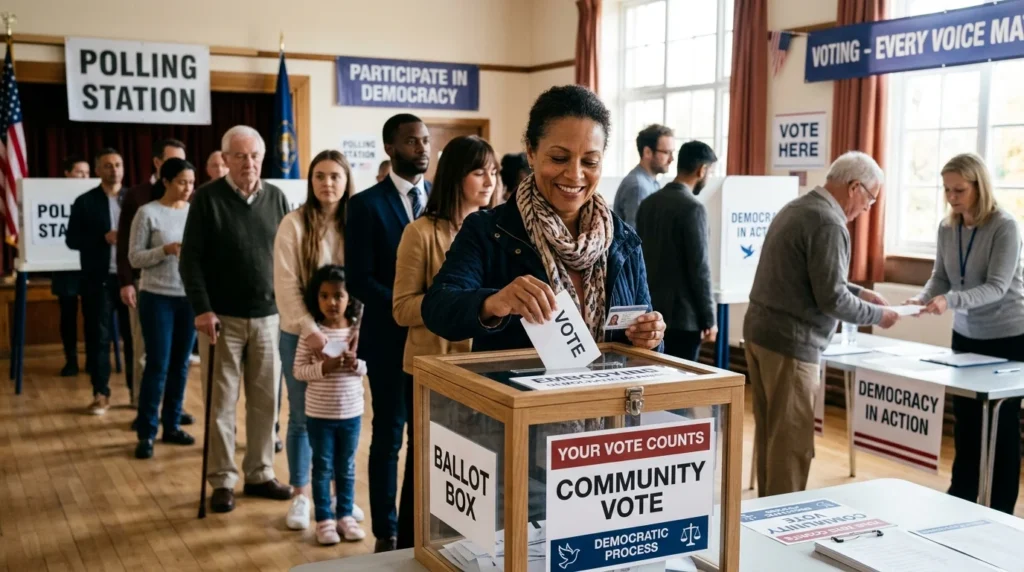
What Does “Democratic” Mean?
The word democratic describes something that relates to, supports, or operates according to the principles of democracy.
Simple Definition
Democratic means involving the participation of people in decision-making, often through voting, representation, and equal rights.
In general, a democratic system gives people a voice in decisions that affect them.
Quick Answer
When something is democratic, it typically emphasizes:
- Participation
- Representation
- Equality
- Voting
- Fairness
- Public involvement
The Origin of the Word Democratic
The term comes from the word democracy, which traces its roots to ancient Greek.
The Greek words are:
- Demos = the people
- Kratos = power or rule
Together, they mean:
“Rule by the people.”
The adjective democratic developed to describe governments, systems, and practices based on those principles.

Democratic Meaning in Politics
The most common use of democratic is in politics.
Democratic Government
A democratic government is one in which citizens participate in selecting leaders and influencing public decisions.
This participation often occurs through:
- Elections
- Voting
- Public representation
- Civic engagement
Key Characteristics
Democratic systems generally include:
- Free elections
- Equal voting rights
- Rule of law
- Political participation
- Protection of individual freedoms
- Accountability of leaders
While democratic governments vary around the world, these principles are often considered central to democracy.
Democratic Meaning in Everyday Life
The word democratic isn’t limited to national governments.
It can also describe everyday decision-making processes.
Family Example
A family might use a democratic approach when deciding:
- Vacation destinations
- Weekend activities
- Household rules
Instead of one person making all decisions, everyone gets input.
School Example
A classroom election is often considered democratic because students participate in choosing representatives or leaders.
Workplace Example
A manager who encourages employee input before making decisions may be using a democratic leadership style.
Democratic Leadership Meaning
One common business term is democratic leadership.
What Is Democratic Leadership?
Democratic leadership is a management style where leaders actively seek input from team members before making decisions.
Characteristics include:
- Collaboration
- Open communication
- Employee involvement
- Shared decision-making
Example
Instead of saying:
“We’re doing this because I said so.”
A democratic leader might say:
“Let’s discuss the options and decide together.”
This approach often increases employee engagement and morale.
How “Democratic” Is Used in Real Conversations
Political Discussion
Person A: “Why is voting important?”
Person B: “Because democratic systems depend on citizen participation.”
Meaning:
People help shape government decisions.
Workplace Example
Employee: “Our manager asks everyone for feedback.”
Colleague: “Sounds like a democratic leadership style.”
Meaning:
Employees participate in decision-making.
School Example
Student: “We’re voting on class representatives.”
Teacher: “That’s a democratic process.”
Meaning:
The group is choosing leaders through voting.
Democratic Meaning in Organizations
Many organizations use democratic principles even when they are not governments.
Examples include:
- Clubs
- Associations
- Cooperatives
- Student organizations
- Nonprofits
These groups may:
- Hold elections
- Vote on policies
- Choose leaders collectively
This allows members to influence decisions.
Democratic Values
The concept of democratic systems is often associated with several core values.
Equality
Every person’s voice should matter.
Participation
People should have opportunities to contribute.
Representation
Leaders should reflect the interests of those they represent.
Accountability
Decision-makers should be responsible for their actions.
Freedom
Individuals should have certain rights and liberties.
These values help define democratic institutions and practices.
Democratic vs Democracy
People often confuse these terms.
Democracy
A noun that refers to a system of government or rule by the people.
Example:
“The country is a democracy.”
Democratic
An adjective describing something related to democracy.
Example:
“The country has democratic elections.”
In simple terms:
- Democracy = the system
- Democratic = describes the system or its features
Common Mistakes & Misunderstandings
Mistake #1: Thinking Democratic Only Refers to Politics
While often political, democratic can also describe:
- Leadership styles
- Organizations
- Schools
- Families
- Community groups
Mistake #2: Assuming Democratic Means Everyone Always Agrees
Democratic systems often involve disagreement.
The key idea is that people have opportunities to participate and express opinions.
Mistake #3: Confusing Democratic With a Political Party
In some countries, the word Democratic may refer to a specific political party.
However, the general term democratic has a broader meaning related to democracy itself.
Mistake #4: Believing Democratic Means Perfect
A democratic system aims to promote participation and representation, but no system is without challenges or imperfections.
Democratic Meaning in Modern Society
Today, democratic principles influence many aspects of life beyond government.
Examples include:
- Community decision-making
- Online groups
- Educational institutions
- Workplace management
- Professional organizations
The idea of involving people in decisions remains a core feature of democratic thinking.
Related Terms and Similar Concepts
If you’re researching the democratic meaning, you may also encounter these related terms.
Democracy
Government or rule by the people.
Voting
A process for making collective decisions.
Representation
Leaders acting on behalf of others.
Citizenship
Membership in a political community.
Participation
Taking part in decision-making.
Elections
Formal voting processes used to choose leaders.
Governance
The way organizations or societies are managed.
These concepts frequently appear alongside discussions of democratic systems.
Why Understanding Democratic Matters
The word democratic is used in:
- News reports
- Political discussions
- Education
- Business management
- Community organizations
Understanding its meaning helps people:
- Follow current events
- Participate in civic life
- Understand leadership styles
- Evaluate decision-making processes
Because democratic principles influence many areas of society, the term remains highly relevant today.